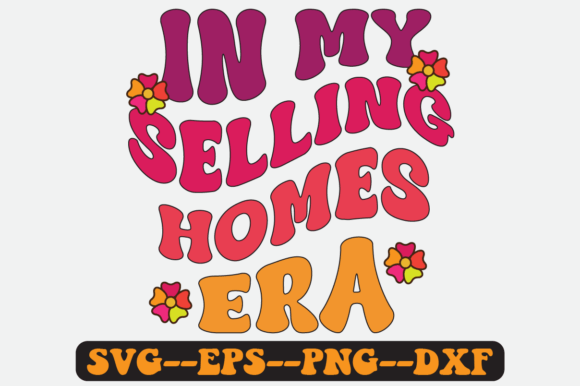
In My Selling Homes Era: Groovy Retro Graphics for Crafts
As a graphic designer who’s built brand identities for over a dozen handmade businesses—from Etsy sellers launching seasonal collections to boutique real estate teams rebranding their client experience—I opened In My Selling Homes Era Groovy Retro SVG expecting nostalgic charm. What I found was more nuanced: a tightly composed, high-fidelity retro illustration that lands squarely between 1970s optimism and modern editorial polish. It doesn’t scream “vintage”—it whispers it, with intention.
A First Impression That Sets the Mood—Not Just the Aesthetic
The design features bold, flowing typography layered over stylized sunbursts, subtle geometric halftones, and soft organic curves. There’s no clutter, no visual noise—just confident negative space and rhythmic line weight. It evokes mid-century advertising meets contemporary lifestyle branding: think artisanal home staging services, curated resale shops, or a local “home styling pop-up” event. For a client whose voice is warm, confident, and slightly playful—not corporate, not kitschy—it’s an instant mood match.
Where This Graphic Design Asset Earns Its Keep in Real Projects
In My Selling Homes Era Groovy Retro SVG shines where personality needs to anchor practicality. In my recent work for a small-batch home goods brand, I used it as the hero graphic on product mockups for vintage-inspired ceramic mugs and linen tote bags. It scaled flawlessly from 2” sticker die-cuts to 24” wall art prints—proof of clean vector construction. As a Cricut project, it cut precisely on cotton twill and sublimation polyester. As a social media graphic, it anchored Instagram carousels announcing “Selling Season Prep Kits”—its retro warmth softened algorithmic coldness without sacrificing clarity.
It also performed well in supporting roles: as a subtle watermark on digital lookbooks, as a border motif on printable staging checklists (a hit with real estate assistants), and even repurposed as a background texture in Canva templates for client-facing PDFs. Because the SVG retains full editability, I adjusted stroke weights to harmonize with their existing sans-serif brand font—and swapped the original mustard tone for their custom sage green palette. That flexibility is rare in off-the-shelf SVG design assets.
Best Fit: Contexts That Celebrate Character
- Product mockups for print-on-demand home decor, apparel, and stationery
- Packaging design accents—especially for gift boxes, tissue wraps, or sticker seals
- Editorial design elements in branded newsletters or blog headers about home transformation
- Seasonal campaign visuals, like “Spring Listing Refresh” or “Summer Home Styling Guide”
- Printable design bundles sold on Etsy: wall art, planners, or client welcome kits
- Sticker design for realtor swag, open house giveaways, or agent-branded notebooks
Use With Intention—Not Everywhere
This isn’t a universal drop-in asset. On minimalist packaging with tight margins or monochrome branding systems, In My Selling Homes Era Groovy Retro SVG can overwhelm. Its energy competes in crowded layouts—say, alongside dense body copy or multiple icons. Avoid it for legal disclaimers, compliance labels, or professional corporate decks where neutrality is non-negotiable. It also loses impact at under 16px in digital UI contexts; the fine linework blurs. And while it pairs beautifully with rounded sans-serifs and friendly display fonts, it clashes with rigid serifs or ultra-thin scripts unless deliberately contrasted.
Design Judgment: Trust, Tone, and Technical Readiness
For client work, emotional resonance matters—but so does reliability. I tested In My Selling Homes Era Groovy Retro SVG across five checkpoints:
- Contrast & legibility: Works cleanly on light and dark backgrounds—but I confirmed readability by converting to grayscale and checking luminance values in Figma.
- Scale integrity: Previewed at 10%, 100%, and 500% in Adobe Illustrator—no stray anchor points or raster artifacts.
- Commercial license verification: Confirmed the included license permits use in client deliverables, resale products (Etsy, Redbubble), and marketing visuals—no attribution required.
- File versatility: The package included SVG, PNG (with alpha channel), and EPS—critical for cross-platform workflows (Cricut Design Space, Canva, Silhouette Studio, and print vendors).
- Typography harmony: Tested against Montserrat, Playfair Display, and Pacifico—each created a distinct but viable brand voice. The design doesn’t dominate; it collaborates.
What stood out was how it elevated perceived professionalism—not despite its retro flair, but because of its precision. Unlike low-res clipart or overused freebie illustrations, this feels intentional, crafted, and commercially mature. It signals that the brand behind it cares about detail—even when leaning into playfulness.
Final Verdict: A Strategic Creative Asset, Not Just Decor
In My Selling Homes Era Groovy Retro SVG isn’t just another digital product you download and forget. It’s a considered creative design tool—one that strengthens visual hierarchy when placed thoughtfully, deepens emotional appeal for lifestyle-adjacent audiences, and supports cohesive brand identity systems without locking you into rigidity. For designers building small business branding, launching Etsy products, or developing print-on-demand lines, it’s a rare find: nostalgic enough to delight, refined enough to trust.
If your client’s story is about transformation, warmth, authenticity—and yes, a little groovy confidence—this graphic design asset doesn’t just fit. It frames.