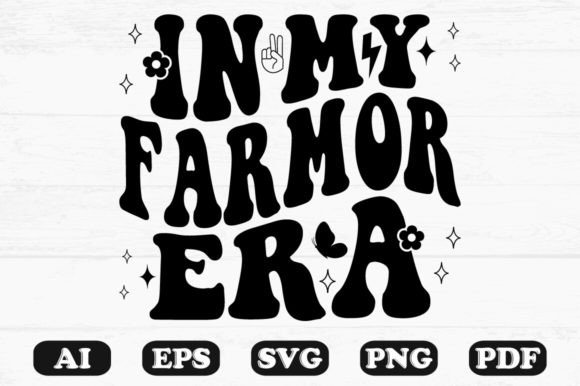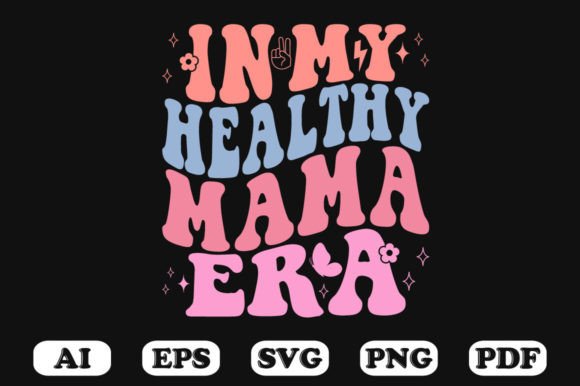
In My Healthy Mama Era Retro Wavy SVG
As someone who’s stitched hundreds of designs onto everything from newborn onesies to boutique aprons, I opened In My Healthy Mama Era Retro Wavy SVG expecting charm—and got something more nuanced. It’s not just a quote; it’s a mood, a moment, and a very specific kind of visual rhythm that lands differently in embroidery than on screen.
A First Stitch Tells You Everything
The wavy baseline is the first thing that catches your eye—not as a gimmick, but as intentional flow. This isn’t jagged or chaotic; it’s soft, rounded, and gently undulating, like breath or a slow exhale. Paired with clean, mid-weight sans-serif lettering (slightly condensed, no serifs, subtle tracking), it reads as confident but unhurried—exactly what “healthy mama era” implies: grounded, self-aware, warm. As an embroidery designer, I immediately pictured this on a heavyweight organic cotton tote bag—something sturdy enough to hold groceries, baby gear, and quiet intention.
Where It Shines in Real Embroidery Projects
In My Healthy Mama Era Retro Wavy SVG works best where personality meets practicality. On a relaxed-fit sweatshirt? Yes—especially in a tonal thread (heather grey on charcoal, oat on cream) for subtle, elevated branding. On a linen tea towel? Absolutely—its gentle curve echoes the drape and texture of natural fiber. For nursery decor, it softens a framed hoop or pillow cover without leaning into cliché. And for Etsy sellers offering personalized baby milestone blankets? It adds emotional resonance without overwhelming the piece.
I’ve used similar retro-wavy typography in commercial embroidery for small-batch boutiques—and customers consistently respond to how *human* it feels. Not polished to sterility, not overly distressed—it sits comfortably between vintage and now. That balance makes it ideal for handmade product lines where authenticity matters more than perfection.
Where to Pause Before Pressing “Start”
This design doesn’t love tight constraints. The wave isn’t just decorative—it’s structural. That means corners and curves need breathing room. On caps or curved surfaces like bucket hats, test stitch placement carefully: the lowest point of the wave may pull or distort if hooped too aggressively. On stretchy fabric (think ribbed knits or lightweight jersey), use cutaway stabilizer *under* and *on top*—not just one layer—to keep the wave’s arc true during stitching.
Small hoop sizes (under 4” height) will compress the rhythm. If you’re embroidering a tiny patch or baby onesie chest area, consider simplifying the wave manually—or skip it entirely for a straight-line version (if your editing software allows). Also, avoid thin fabrics like voile or challis unless you’re backing them heavily: the fill areas in the letters can telegraph through, especially in light thread on dark fabric.
Thread & Fabric Pairing Notes
- Dark fabric? Use matte, high-contrast thread (navy on rust, charcoal on olive)—avoid metallics here; they flatten the wave’s subtlety.
- Light fabric? Go warm-toned ecru or terracotta instead of stark white—keeps the retro vibe intact.
- Fabric texture matters. On burlap or heavy terry, simplify stitch density slightly—dense fills + coarse texture = muddied edges.
- Wash durability? Satin-stitched outlines hold up better than pure fill-stitch lettering over time. Check whether In My Healthy Mama Era Retro Wavy SVG uses outlines—if not, add a 0.3mm satin border in your embroidery software before stitching.
What It Does for Your Craft Business
This isn’t just another text-based SVG—it’s a micro-branding tool. When customers see it on a custom embroidered apron at a local farmers’ market, they don’t just read “healthy mama.” They feel permission—to rest, to nourish, to show up imperfectly. That emotional resonance lifts perceived value. A $38 linen apron becomes a keepsake. A $24 baby onesie becomes a registry favorite. For Etsy sellers, pairing In My Healthy Mama Era Retro Wavy SVG with soft photography and genuine copy (“Stitched slowly, worn lovingly”) builds trust faster than generic slogans.
It also plays well across formats: as a standalone machine embroidery design, as part of a themed bundle (e.g., “Nurture Collection” with matching botanical motifs), or even scaled down for iron-on patches. Just remember—its strength lies in its simplicity, so don’t over-accessorize it with extra flourishes unless your brand voice matches.
Practical Designer Checks Before You Stitch
- Test on scrap fabric *first*, using your exact stabilizer + thread combo.
- Check stitch density—especially in the thinnest parts of the wave. If it looks sparse or broken, adjust underlay or add a second pass.
- Confirm hoop size compatibility. If your machine maxes out at 5×7”, verify the full wave fits comfortably within that frame—including clearance for jump stitches.
- Inspect small details: Are terminals (start/end of letters) cleanly tapered? Do curves stay smooth at slow speeds?
- Review licensing. Since this is listed as a Graphics product in Crafts, confirm whether commercial use (selling finished embroidered items) is permitted—and whether resale of the digital file itself is restricted.
- Mock it up in black and white first. If the wave disappears or flattens in grayscale, it’ll lack impact on textured or busy backgrounds.
At its core, In My Healthy Mama Era Retro Wavy SVG succeeds because it respects both the craft and the customer. It doesn’t shout. It sways. And in a market saturated with sharp edges and forced urgency, that gentle motion is exactly what makes it memorable—on fabric, on skin, and in the mind.